
Tools and evidence for measuring belonging in community
settings.
Free measurement guidance, Australian and global research on loneliness and social connection, and a starter set of belonging measures you can start using right now.
From the talk at Ending Loneliness Together's National Loneliness Conference 2026.
‘Making room for connection by design: building and measuring belonging as a continuity layer for community programs’
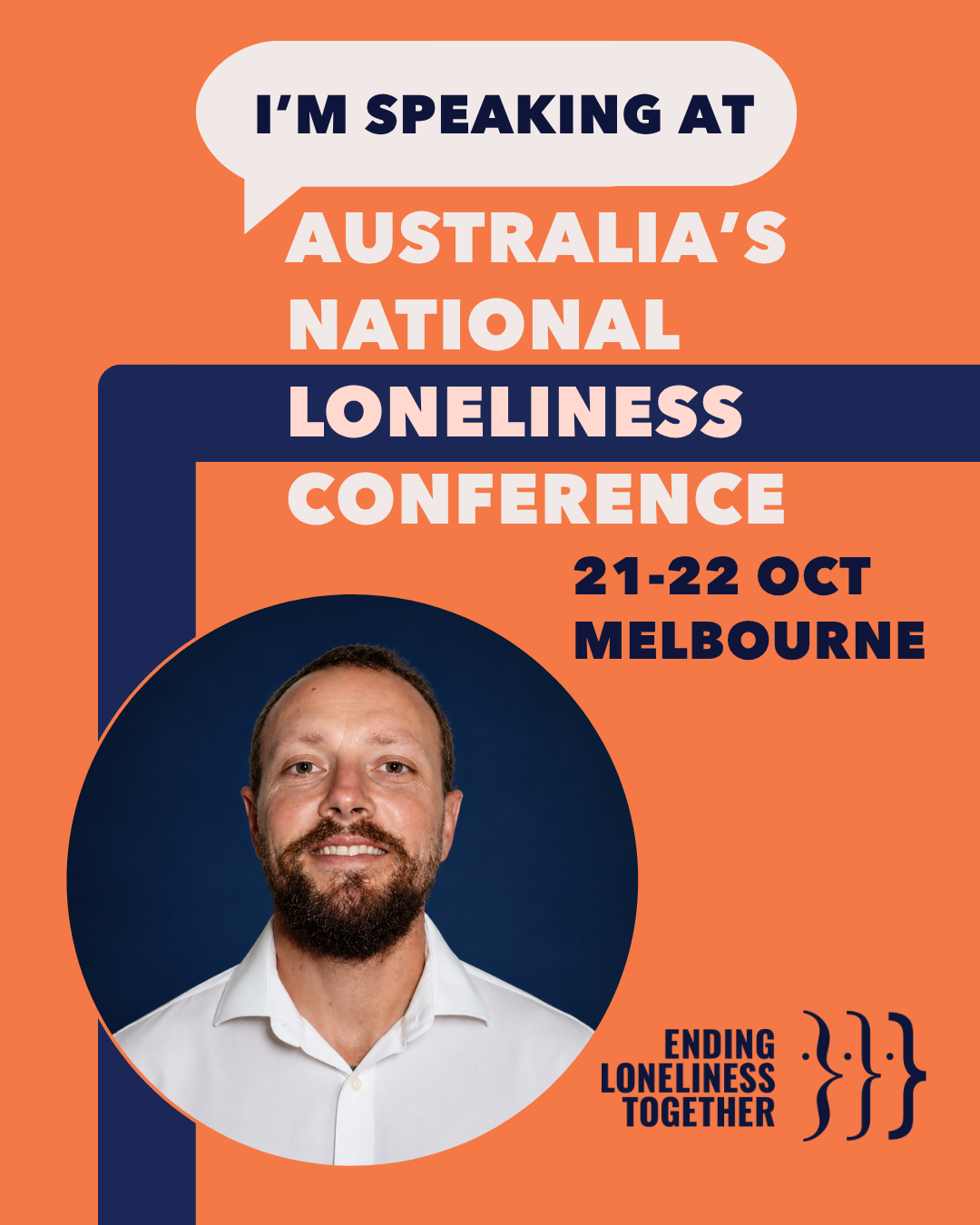
Nick Mayes, Founder of CoNectar
Free to use right now in your program
for you members
The 5 practical questions to ask right now
of your program
Available after October 22
See how it could help you
Evidence and guidance for programs measuring connection
Work we think is genuinely worth your time, from organizations other than us. Updated as new research lands.
A Guide to Measuring Loneliness for Community Organisations
Badcock and Lim. The practical starting point if your organization wants to measure loneliness properly and isn't sure which instrument to use.
State of the Nation: Social Connection in Australia 2026
A survey of 4,001 Australians aged 12 to 95. One in two report some form of social disconnection, and the report maps who is most affected and what protects people.
The full ELT resource library
Evaluation and reporting guides for community organizations, white papers, and a plain-language summary of the WHO Commission report. All open access.
From Loneliness to Social Connection
The flagship report of the WHO Commission on Social Connection, making the global case for treating connection as a public health priority.
Our Epidemic of Loneliness and Isolation
The advisory that put social connection on the public health agenda, with a framework for what communities and organizations can do.
Social Relationships and Mortality Risk
The landmark meta-analysis showing social relationships predict survival on a scale comparable to well-known health risks.
Measuring What Matters: the case for loneliness
ELT's submission arguing for loneliness as a national wellbeing indicator. Useful framing if you're making the case for connection funding internally.
Measuring loneliness: guidance for charities
How to use the ONS measures in program evaluation, written for people responsible for monitoring rather than researchers. Now a preserved archive.
Loneliness measures and guidance hub
A curated catalogue of measurement tools, evaluation guides and toolkits from national and local loneliness campaigns.
Wellbeing in Victoria: A Strategy to Promote Good Mental Health 2025–35
A ten-year strategy with connected communities as one of eight priorities, and a push for better data and shared measurement across organizations.
Social Inclusion Action Groups: guidelines for local government
How all 79 Victorian councils run their Social Inclusion Action Groups, including participant surveys, six-monthly reporting and independent evaluation.
Mental Health and Wellbeing Locals: service framework
How the new Locals work, with peer support and social connectedness built into the service model.
The prevalence, causes and impacts of loneliness in NSW
The NSW Legislative Council inquiry. Final report tabled August 2025, with the government's response in November 2025.
Communities Innovation Fund: responses to social isolation and loneliness
Grants of up to $200,000 a year for community organizations trying new approaches to isolation and loneliness.
The Health Revolution: Our pathway for living well in Tasmania 2026–2046
Tasmania's 20-year preventive health strategy, launched in June 2026.
Social Prescribing in the Australian Context: A National Feasibility Study
Calls for a national minimum data set and evaluation framework, and for real investment in the community organizations people are referred to.
Action Guide for Building Socially Connected Communities
A free six-step process for local leaders, from understanding local connection to measuring impact and sharing what works.
Groups 4 Health
An Australian group program that builds social group membership, with trial evidence that it reduces loneliness and improves mental health.
Social isolation and loneliness in Australia
The official national data, drawn from the HILDA Survey, with trends by age and gender.
Understanding and defining loneliness and social isolation
A clear practitioner guide to the difference between feeling lonely and being isolated, and why it matters for your program.
Loneliness and Social Isolation as Risk Factors for Mortality
The follow-up meta-analysis showing loneliness, isolation and living alone each carry their own mortality risk.
GILC
The international network, co-founded by Ending Loneliness Together, connecting researchers, policymakers and practitioners.
Measuring belonging, answered simply
Short answers to the questions we hear most from people running community programs.
How can a community program measure belonging?
Start with a short set of plain-language questions asked at the beginning and end of your program, alongside a validated loneliness measure. Our free Belonging Index is five questions and gives a score out of 100. To see connection as it happens, not just at the end, you also need a way to observe how members engage with each other between sessions.
What is the difference between loneliness and social isolation?
Social isolation is about how few connections someone has. Loneliness is the painful feeling that your connections don't meet your needs. Someone can be surrounded by people and still feel lonely, which is why programs benefit from measuring both.
Why does the time between sessions matter?
Most programs meet weekly or fortnightly, so members spend far more time between sessions than in them. That in-between is where early connections either grow or fade, and it's usually the part of a program with the least support and the least visibility.
Are there free tools for measuring loneliness?
Yes. The UCLA Loneliness Scale and the ONS single-item measure are both free and widely used. Ending Loneliness Together's guide for community organisations is the best Australian starting point for choosing between them.